" Alaafin Owoade does not seek personal glory or recognition but is more invested in elevating those around him. He rules not from the front with a loud, authoritative voice, but from within, empowering his people to grow and succeed. And yet, underneath this soft, empathetic exterior lies the heart of a lion—brave, bold, and unafraid of challenges. The strength of a lion is used not to intimidate but to inspire. Alaafin Owoade's courage comes from a place of deep belief in his mission and a desire to protect and guide his people through adversity".
By Bode Durojaiye, Director of Media and Publicity to the Alaafin, Paramount Ruler of Oyo Kingdom and Superior Head of Yorubaland.
Leadership is often associated with boldness, power, and control—qualities embodied by the lion, the king of the jungle. On the other hand, the lamb conjures images of gentleness, vulnerability, and submission.
But what happens when a leader embodies both? When humility meets courage, and empathy stands beside authority, a unique leadership style emerges—a lamb with a lion’s heart. This paradoxical combination is a quiet but formidable force, reshaping the way we think about leadership in today’s world.
The Lamb: Quiet, Empathetic, and Grounded
The Alaafin, Paramount Ruler of Oyo Kingdom and the Superior Head of Yorubaland, His Imperial Majesty, Oba Engineer Abimbola Akeem Owoade 1, is from all intents and purposes a lamb-like Monarch who doesn’t immediately command attention with his presence or bark orders with an iron fist.
Instead, he listens, observes, and understands.
In a world often filled with noise and ego, this quiet style stands out for its rare, understated power.
Alaafin Owoade creates an environment where his people feel seen and heard—where every voice matters, and no one is just a cog in the wheel.
What makes the Royal lamb powerful is its empathy. Iku Baba Yeye doesn’t rush to judge or demand results at the expense of people’s well-being. Instead, he fosters collaboration, trust, and an inclusive culture where innovation thrives.
He is not afraid to share ideas, admit mistakes, or challenge the status quo, because he knows his rulership has his back.
In many ways, a lamb-like Monarch embodies servant leadership. His primary goal is to support and uplift his people, helping others shine.
He does not seek personal glory or recognition but is more invested in elevating those around them. He rules not from the front with a loud, authoritative voice, but from within, empowering his people to grow and succeed. And yet, underneath this soft, empathetic exterior lies the heart of a lion—brave, bold, and unafraid of challenges.
Oba Owoade is very decisive, courageous and visionary.
At first glance, a lion-like Royal Father may seem like the complete opposite of a lamb. Lions are often seen as fierce, powerful, and relentless. They make bold decisions, take risks, and assert their dominance in times of uncertainty. Yet, in the metaphor of a lamb with a lion’s heart, these two qualities don’t conflict—they complement each other.
A Paramount Ruler with a lion’s heart knows when to be decisive. He understands that while empathy and understanding are vital, there are moments when his people needs direction, clarity, and unwavering courage.
Alaafin Owoade is not afraid to make the tough calls, take bold risks, or confront uncomfortable truths. In times of crisis, he steps up and lead with conviction, ensuring that the people doesn’t waver or lose sight of the goal.
But here’s the key difference: the lion-like courage of Iku Baba Yeye is not driven by ego or a desire for power. It’s driven by purpose. His roar is not about asserting dominance or control but about rallying his people toward a common vision.
The strength of a lion is used not to intimidate but to inspire. Alaafin Owoade's courage comes from a place of deep belief in his mission and a desire to protect and guide his people through adversity.
Iku Baba Yeye is a lion-hearted Royal Father who embodies fearless, strategic, and protective authority, driving his people with unwavering confidence and purpose.
His key traits include immense courage, strategic vision, decisive action in crises, and a nurturing, protective, and empowering nature towards his "pride" (people).
He is self-reliant, resilient, and command respect rather than demanding it.
Alaafin Owoade tackles challenges head-on, walking through storms rather than fleeing them. He is brave enough to make dramatic changes and pursue unconventional paths. He makes firm, calculated, and timely decisions, especially during uncertain times.
In Yoruba traditional governance, titles are not casual labels; they are repositories of history, authority, and sacred responsibility. Within the Oyo royal heritage, few stools have been as persistently misunderstood as that of the Ona-Aka. According to authentic Oyo tradition, the Ona-Aka of Oyo is not merely a local functionary or peripheral chief. Rather, the Ona-Aka is a principal royal figure whose stool is deeply rooted in, and inseparable from, the institution of the Alaafin of Oyo. To understand this is to appreciate the sophistication of the Oyo political system and the care with which it balanced lineage, power, and spirituality.
The Oyo Empire was governed by a clearly defined constitutional order in which every office had meaning and limits. Kingship was sacred, but it was also structured. Titles emerged from lineage, ritual necessity, and historical experience, not from administrative convenience. It is within this carefully calibrated system that the Ona-Aka must be situated.
Historically, the Ona-Aka is known as Bàbá Àgbà Ajaka, a direct biological son of Alaafin Oluaso, the seventh Alaafin of Oyo and the longest-reigning monarch in Oyo history. It is popular among historians that Alaafin Oluaso had over a hundred children, with 27 taking principal roles in the administration of the empire. This ancestry establishes the Ona-Aka as royalty in the strictest sense.
Alongside Ona-Ishokun and Ona-Omo-Nla, the Ona-Aka constitutes one of the three major principal royal lineages of Oyo-Alaafin. These three lineages together form the Bàbá-Ọba, translated as the Fathers of the King. This institution is one of the most distinctive features of the Oyo traditional system.
In Oyo tradition, a reigning Alaafin must not have a living biological father. The rationale is both political and spiritual: the king must stand alone as the supreme authority and symbolic embodiment of the state. Alaafin is seen, not as a king but as a god! To resolve this, Oyo created the Bàbá-Ọba, official fathers who provide moral guidance, ritual legitimacy, and ancestral continuity to the Alaafin. The Ona-Aka, as one of these fathers, occupies a role that is constitutional.
Beyond the Bàbá-Ọba, the Oyo royal system also recognises the Ọmọ-Ọba class, regarded as the official royal brothers of the Crown. While the Bàbá-Ọba are three in number, the Ọmọ-Ọba are six: Baba Iyaji, Atingisi, Agunpopo, Olusami, Arole-Oba, and Arole-Iya-Oba.
What is critical to understand is that both groups, the Bàbá-Ọba and the Ọmọ-Ọba, belong to one extended royal family. Historically and traditionally, they are blood relations of the Alaafin. As a result, intermarriage among them is strictly prohibited. This prohibition reinforces their shared ancestry and preserves the sanctity of the royal line.
Members of these royal families bear names that are peculiar to Oyo-Alaafin royalty; names such as Afonja, Ogboja, Agboin, Sanda, Tella, Akee, Ogoo, etc. These names function as historical markers, linking present generations to the founding lineages of Oyo. The Ona-Aka stool exists firmly within this royal framework.
The Ona-Aka stool is a significant and ancient institution within the Oyo royal family. From its inception, it has been an integral part of the Alaafin institution. It is not an appendage to kingship but one of its sustaining pillars. The relationship between the Alaafin and the Ona-Aka is not episodic; it is structural and enduring.
Among the three Bàbá-Ọba, the Ona-Aka is the eldest. This seniority carries both symbolic and practical significance. The Ona-Aka serves as the chief custodian of Òrì, the Yoruba deity of destiny. In Yoruba cosmology, Òrì represents an individual’s fate and spiritual essence. That the king’s destiny is ritually entrusted to the Ona-Aka underscores the spiritual authority of the stool.
While the Ona-Aka holds seniority, the Ona-Ishokun is next, often regarded today as the most prominent among the trio, largely because the Ona-Ishokun lineage descends directly from Alaafin Abiodun Adegoolu, one of Oyo’s most celebrated rulers. This balance is expressed in the traditional saying:
“Ona-Aka Baba Ishokun, Ona-Ishokun Baba Oba.”
The proverb affirms hierarchy, lineage, and interdependence within the royal system.
The progenitor of the Ona-Aka lineage in present-day Oyo was Kibitiola of Oyo-Ile, who became the first Ona-Aka in this era. He served alongside Alaafin Atiba Adewimbi Olujide Atobatele, playing the role of a royal elder during the rebuilding of Oyo-Atiba after the collapse of Old Oyo. The fall of Oyo-Ile, the capital of the Yorubas was not because it was overrun by Fulani marauders, but people left the city in fear of reprisal attack after the death of Alaafin Oluweu in war. Oyo’s scattered across, formed new cities/towns/villages across Yorubaland.
Kibitiola was succeeded by his son, Ogunjinmi Aleyo, the second Ona-Aka in Oyo-Atiba. Ogunjinmi Aleyo was renowned for wisdom, restraint, and courage. His role in safeguarding the sacred throne of the Alaafin during the Ijaiye War remains a defining chapter in Oyo history. Such responsibility was entrusted to him because of his position as a royal father, not as a subordinate chief.
The third Ona-Aka, Okesina, further exemplifies the stool’s centrality. In his role as custodian of Òrì, he bestowed the name Orimadegun on Alaafin Bello Gbadegesin Oladigbolu II. Historical accounts also record that Alaafin Oladigbolu II spent his formative years in the Ona-Aka Agunpopo royal court, under Okesina’s guardianship and mentorship. This level of intimacy reflects a relationship of fatherhood, not hierarchy.
One of the most telling traditions underscoring the Ona-Aka’s status concerns marriage. When an Ona-Aka joins his ancestors, custom dictates that the reigning Alaafin should marry one of his widows. This practice reinforces continuity between the stools and affirms their shared royal essence.
Thus, following the death of Adeyanju, the fourth Ona-Aka in Oyo-Atiba, Alaafin Siyanbola Adegboyega Akanbi Oladigbolu married Adewoyin, one of Adeyanju’s widows and the mother of Okediji, as a queen. Such a tradition would be inconceivable if the Ona-Aka were not firmly embedded within the royal institution.
In Oyo’s palace, governance is shared between the king, senior chiefs, and the royal women, especially the Ayaba. Other palace chiefs such as the Ilari and Emese served as royal messengers, administrators, and enforcers of palace decisions, ensuring communication between the Alaafin and the wider kingdom .
There are many important offices for women, the Iya Ile Ori, Iya Ile Agbo, Iya Mode, Iya Kere, Iya’le Oduduwa, Iya Ode, Eni Oja, etc. The Ayabas, particularly the senior queen (Iyale), played an important political and ceremonial role. She managed the inner palace, supervised royal wives and attendants, and acted as a trusted confidant of the Alaafin. In some cases, the Ayaba influenced political decisions through counsel and palace networks, reflecting the significant though subtle power of royal women in Oyo governance.
The Ona-Aka stool is therefore historically, traditionally, and institutionally inseparable from the Alaafin of Oyo. It is a cornerstone of the Yoruba traditional system as practised in Oyo, embodying lineage, spiritual authority, and constitutional responsibility. To understand the Ona-Aka is to understand the depth and sophistication of Oyo’s royal heritage, and to preserve it accurately for generations yet to come.
Written by:
Prince Afolabi Aderemi, an Oyo prince of the Tella Gbaagi Olufunu Agunloye ruling house and a diaspora leader based in Lisbon, Portugal.
The conference center at the World Economic Forum in Davos, Switzerland is being evacuated with no further information on the cause.
A reporter on the scene described an unusual smell that is 'making some people in our area cough.'
Hundreds of business leaders and government officials have descended on the forum for the five day event, gathering to discuss pressing global issues.
Donald Trump announced on Truth Social on Wednesday that he would be scrapping tariffs for European allies that opposed his plans to purchase Greenland.
He claimed that he had reached a 'framework deal' in acquiring Greenland in a meeting with Secretary General of NATO, Mark Rutte, at the WEF.
'This solution, if consummated, will be a great one for the United States of America, and all NATO Nations. Based upon this understanding, I will not be imposing the Tariffs that were scheduled to go into effect on February 1st,' he said.
Trump said 'additional discussions' were to be had regarding the Golden Dome missile defense system.
Prime Minister Sir Keir Starmer, right, said he would discuss the tariffs with US President Donald Trump. | Credit: PA Wire/PA Images
Denmark, Finland, France, Germany, the Netherlands, Norway, Sweden and the UK have issued a joint statement after US President Donald Trump threatened to ramp up tariffs until a deal is reached for it to buy Greenland.
In a unified response, European leaders warned that “tariff threats undermine transatlantic relations and risk a dangerous downward spiral."
Their response comes after the US president said on Saturday that the UK will be charged a 10% tariff “on any and all goods” sent to the US from February 1, increased to 25% from June 1, until a deal is reached for Washington to purchase Greenland from Denmark.
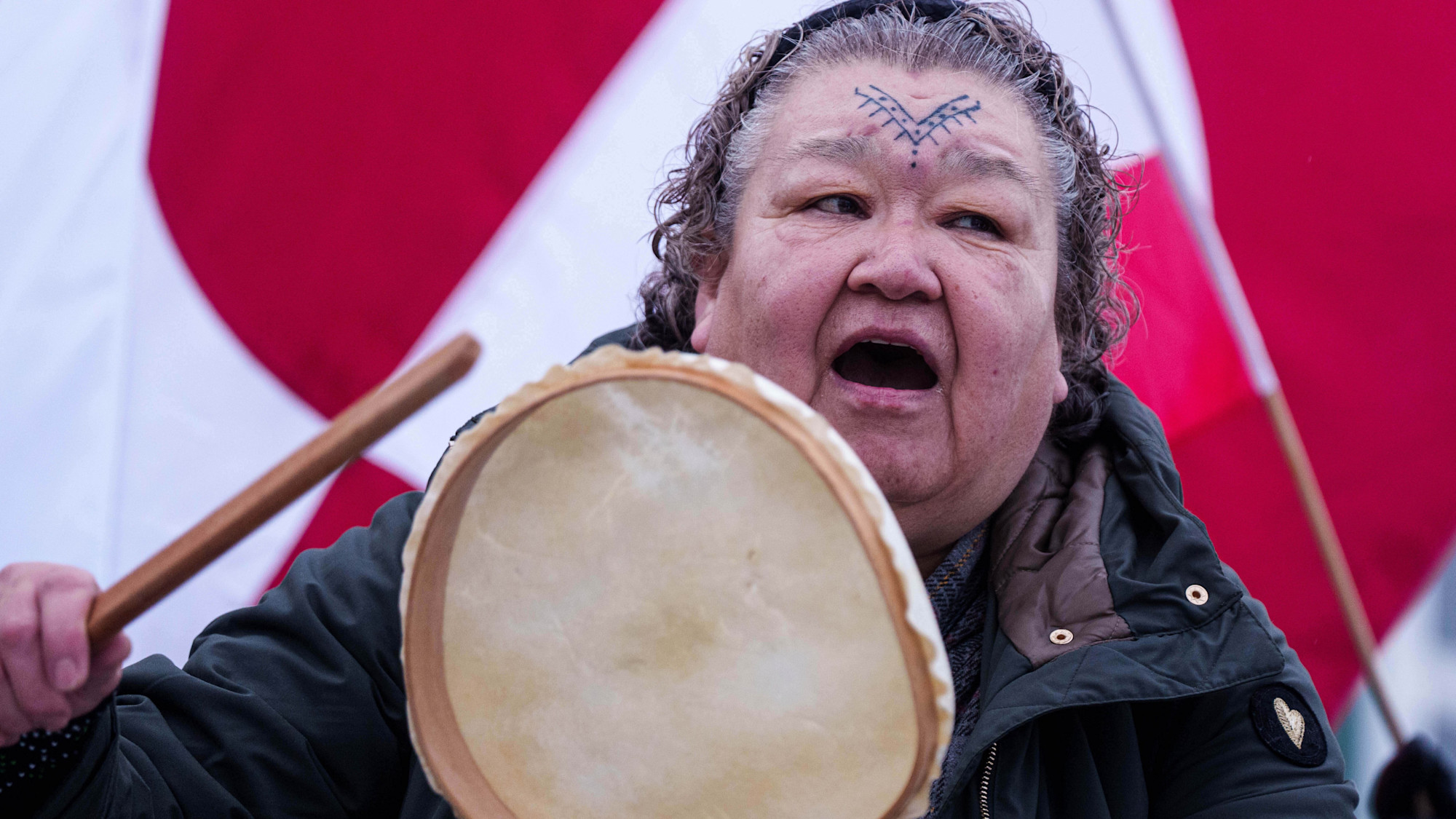
An Inuit woman sings a national song during a protest against Trump's policy towards Greenland on Saturday. Credit: AP
Trump's announcement on Saturday was met with condemnation by Sir Keir Starmer and fellow European leaders, who criticised the US president's plan, with Sweden's prime minister saying they would not be "blackmailed".
Responding to the tariffs, the joint statement reads: “As members of Nato, we are committed to strengthening Arctic security as a shared transatlantic interest. The pre-coordinated Danish exercise Arctic Endurance, conducted with Allies, responds to this necessity. It poses no threat to anyone.
“We stand in full solidarity with the Kingdom of Denmark and the people of Greenland. Building on the process begun last week, we stand ready to engage in a dialogue based on the principles of sovereignty and territorial integrity that we stand firmly behind.
“Tariff threats undermine transatlantic relations and risk a dangerous downward spiral. We will continue to stand united and coordinated in our response. We are committed to upholding our sovereignty.”
Trump's intended levies would apply to Denmark, Norway, Sweden, France, Germany, the Netherlands and Finland as well as the UK after they had “journeyed to Greenland, for purposes unknown”, Trump said.
On Saturday, Starmer said Trump’s decision was “completely wrong” adding that he would be “pursuing this directly” with the US administration.
Sweden’s Prime Minister Ulf Kristersson said “we will not let ourselves be blackmailed”, while French President Emmanuel Macron said he would hold talks with European partners and would not bow to “intimidation”.
Finland’s Prime Minister Petteri Orpo said tariffs would be in “no one’s interest”, with Norway’s Prime Minister Jonas Gahr Store writing on social media: “Threats have no place among allies.”
Speaking on Sunday, Culture Secretary Lisa Nandy said the UK’s position on Greenland is “non-negotiable”.
She echoed Starmer's statement, telling Sky News’ Sunday Morning With Trevor Phillips: “We believe that this decision on tariffs is completely wrong.”
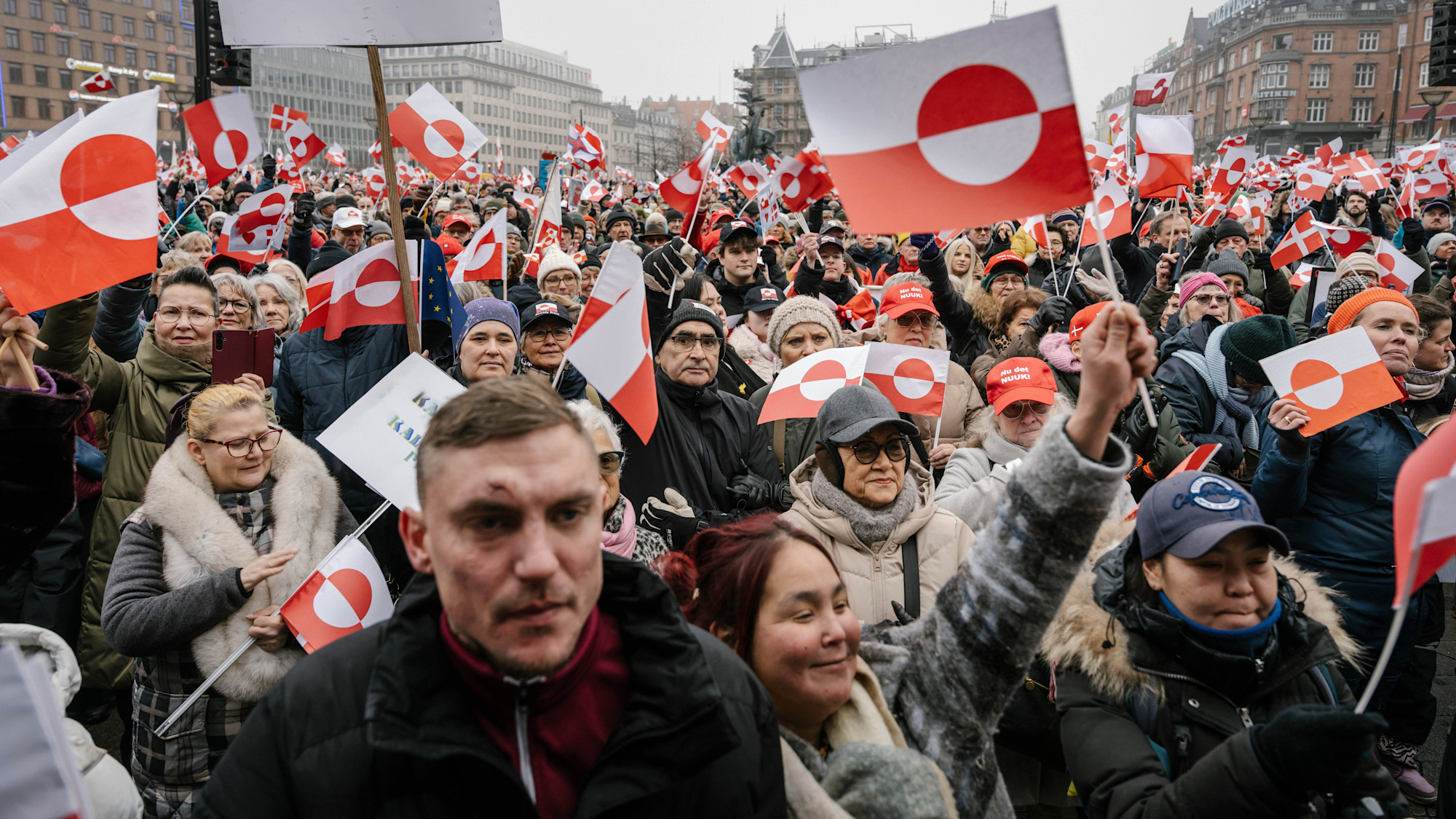
People march during a pro- Greenlanders demonstration, in Copenhagen, Denmark, Saturday. Credit: AP
Earlier this week, the UK confirmed it had sent a military officer to Greenland as Denmark stepped up its military presence in the Arctic and High North.
Downing Street said they were sent at Denmark’s request to join a reconnaissance group ahead of a planned Arctic endurance exercise, but denied it amounted to a “deployment”.
In a post on Truth Social on Saturday, Trump said: “These Countries, who are playing this very dangerous game, have put a level of risk in play that is not tenable or sustainable.
“Therefore, it is imperative that, in order to protect Global Peace and Security, strong measures be taken so that this potentially perilous situation end quickly, and without question.”
Trump said the US was “immediately open to negotiation with Denmark and/or any of these Countries that have put so much at risk, despite all that we have done for them, including maximum protection, over so many decades”.
He said it was “time for Denmark to give back”, adding: “China and Russia want Greenland, and there is not a thing that Denmark can do about it.”
The British prime minister said: “Our position on Greenland is very clear – it is part of the Kingdom of Denmark and its future is a matter for the Greenlanders and the Danes.
“We have also made clear that Arctic security matters for the whole of Nato and allies should all do more together to address the threat from Russia across different parts of the Arctic.
“Applying tariffs on allies for pursuing the collective security of Nato allies is completely wrong. We will of course be pursuing this directly with the US administration.”
EU leaders said the Danish exercise “poses no threat to anyone” and warned tariffs would risk a “dangerous downward spiral” in transatlantic relations.
European Commission President Ursula von der Leyen and European Council President Antonio Costa said: “The EU stands in full solidarity with Denmark and the people of Greenland. Dialogue remains essential, and we are committed to building on the process begun already last week between the Kingdom of Denmark and the US.
“Tariffs would undermine transatlantic relations and risk a dangerous downward spiral. Europe will remain united, coordinated, and committed to upholding its sovereignty.”
The EU’s foreign policy chief said tariffs could make the US and EU poorer and boost China and Russia.
Former Estonian prime minister Kaja Kallas said on social media: “China and Russia must be having a field day. They are the ones who benefit from divisions among Allies.
Trump’s move prompted criticism across the board from UK politicians who fear for their impact on
Earlier this week, the UK confirmed it had sent a military officer to Greenland as Denmark stepped up its military presence in the Arctic and High North.
Downing Street said they were sent at Denmark’s request to join a reconnaissance group ahead of a planned Arctic endurance exercise, but denied it amounted to a “deployment”.
In a post on Truth Social on Saturday, Trump said: “These Countries, who are playing this very dangerous game, have put a level of risk in play that is not tenable or sustainable.
“Therefore, it is imperative that, in order to protect Global Peace and Security, strong measures be taken so that this potentially perilous situation end quickly, and without question.”
Trump said the US was “immediately open to negotiation with Denmark and/or any of these Countries that have put so much at risk, despite all that we have done for them, including maximum protection, over so many decades”.
He said it was “time for Denmark to give back”, adding: “China and Russia want Greenland, and there is not a thing that Denmark can do about it.”
The British prime minister said: “Our position on Greenland is very clear – it is part of the Kingdom of Denmark and its future is a matter for the Greenlanders and the Danes.
“We have also made clear that Arctic security matters for the whole of Nato and allies should all do more together to address the threat from Russia across different parts of the Arctic.
“Applying tariffs on allies for pursuing the collective security of Nato allies is completely wrong. We will of course be pursuing this directly with the US administration.”
EU leaders said the Danish exercise “poses no threat to anyone” and warned tariffs would risk a “dangerous downward spiral” in transatlantic relations.
European Commission President Ursula von der Leyen and European Council President Antonio Costa said: “The EU stands in full solidarity with Denmark and the people of Greenland. Dialogue remains essential, and we are committed to building on the process begun already last week between the Kingdom of Denmark and the US.
“Tariffs would undermine transatlantic relations and risk a dangerous downward spiral. Europe will remain united, coordinated, and committed to upholding its sovereignty.”
The EU’s foreign policy chief said tariffs could make the US and EU poorer and boost China and Russia.
Former Estonian prime minister Kaja Kallas said on social media: “China and Russia must be having a field day. They are the ones who benefit from divisions among Allies.
Trump’s move prompted criticism across the board from UK politicians who fear for their impact on the economy.
Tory leader Kemi Badenoch said Trump was “completely wrong” to impose tariffs over Greenland, adding they would be a “burden for businesses across our country”.
Reform leader Nigel Farage said the tariffs would “hurt” the UK, and Liberal Democrat leader Sir Ed Davey said Trump was “punishing” the UK.
Hundreds of people in Greenland’s capital Nuuk attended a rally on Saturday in support of self-governance.
Thousands also took part in rallies across Denmark on Saturday opposing any US takeover of Greenland.
Since the US began openly discussing the annexation of Greenland at the start of 2026, the UK has stepped up discussions on Arctic security with Starmer raising the issue in calls with Trump, the Danish Prime Minister Mette Frederiksen and Nato secretary-general Mark Rutte.
The British Chambers of Commerce said Trump’s proposed tariffs on Greenland will have a “greater impact” on UK exports if they are stacked on existing tariffs.
William Bain, its head of trade policy, told the Press Association: “If there’s stacking of these duties and that is how the US government intends to implement this statement tonight, then these tariffs would have a greater impact upon UK goods exports to the US than even the Rose Garden statement of April 2 had last year.”